
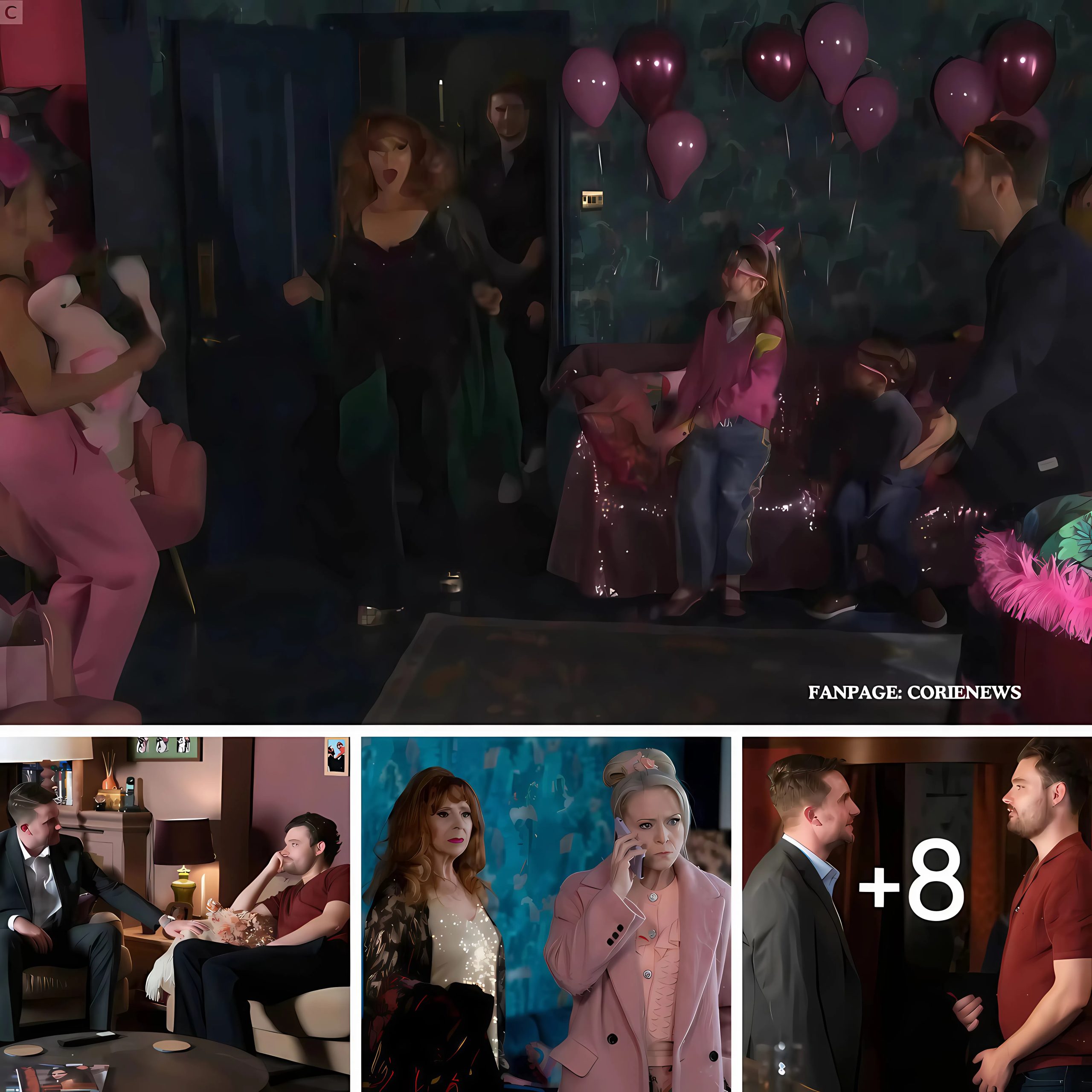
BIG SURPRISE AHEAD!!! Eastenders Linda and Johnny surprise Elaine max Callum and Lexi with a flamingo lounge party scene
In the latest emotionally charged and unexpectedly playful installment of EastEnders, Walford once again proves that even the most ordinary night can spiral into something chaotic, theatrical, and strangely heartwarming. What begins as a simple evening at home quickly transforms into a full-blown themed surprise party, complete with neon décor, over-the-top costumes, and a family dynamic that swings wildly between affection, embarrassment, and comic disbelief.
The episode opens with Elaine Peacock in one of her signature moods—half proudly defensive, half suspicious of anything happening outside her control. She is busy admiring her latest obsession: a collection of flamboyant decorative peacocks that have taken over her space, much to the mixed reactions of everyone around her. She is convinced the house finally has “character,” while others quietly think it has become a chaotic aviary museum.
Johnny Carter and Linda Carter, however, are clearly up to something. They exchange subtle glances, trying to contain their excitement, as they prepare what they insist is a harmless “surprise.” Elaine immediately senses something is off, interrogating them with her usual mix of affection and suspicion. Linda tries to play it cool, insisting everything is normal, while Johnny awkwardly blocks any attempt she makes to wander into the main lounge area.
Behind the scenes, Callum Highway is also involved, reluctantly drawn into the chaos, while Max Branning lurks nearby with his trademark smirk, clearly expecting things to go wrong but not yet sure how spectacularly. Lexi Pearce, meanwhile, is the only one who seems genuinely excited, sensing that something fun is about to unfold even if the adults are doing their best to complicate it.
The tension breaks when Johnny finally announces the surprise. With dramatic flair and a hint of nervous pride, he declares: “Welcome to THE FLAMINGO LOUNGE.” At that moment, the doors swing open to reveal a fully transformed living space—glowing pink lights, flamingo cutouts, glittering decorations, and a party setup so exaggerated it almost feels like a nightclub has been dropped into the middle of Albert Square.
Elaine is instantly stunned. Her reaction is loud, sharp, and immediate—she calls it “an outrage,” though her eyes betray a flicker of fascination. The contrast between her outrage and the absurdity of the setup creates an instant comedic tension. Linda, trying to defend the transformation, explains that the idea was to bring “bird balance” into the house, pointing out that Elaine’s peacock obsession had already taken things in a rather extravagant direction.
That comment triggers a chain reaction. Elaine, offended at first, begins to defend her taste, insisting her peacocks represent elegance and sophistication. Linda counters that flamingos bring “fun, warmth, and a bit of chaos,” which, ironically, already seems to be present in abundance. Johnny watches the exchange unfold like someone trying not to laugh during a formal event, while Callum quietly assesses whether any part of the house will survive the night intact.
Max, never one to miss an opportunity to provoke, mutters that “bird balance” sounds like something made up to justify bad decorating decisions. Elaine fires back instantly, warning him not to test her patience, while Lexi tries to mediate by clapping and calling the setup “amazing,” effectively diffusing the tension for a moment.
As the initial shock fades, something surprising happens—Elaine begins to soften. She walks slowly through the Flamingo Lounge, taking in every detail. The music system hums softly in the background, pink lights reflecting off glassware, and even the furniture has been subtly rearranged to match the theme. Despite herself, she admits that it is “a tiny bit impressive,” though she refuses to fully surrender her authority over the aesthetic direction of the house.
Johnny, sensing an opening, presents a more heartfelt element of the surprise. He and Linda reveal that the Flamingo Lounge is not just about decoration—it is meant as a reminder that everyone in the family should be proud of who they are, even when they feel loud, messy, or unconventional. The flamingo motif, they explain, symbolizes confidence, individuality, and not apologizing for standing out.

Elaine is visibly moved, though she tries to hide it behind sarcasm. She remarks that she has “never forgotten how to be fabulous,” but her softened tone betrays the emotional weight behind the moment. For a brief pause, the usual tension in the room shifts into something warmer and more reflective.
Callum, who has been quietly observing, acknowledges that the effort is actually thoughtful. Even Max, though still skeptical, seems slightly less combative as he takes in the atmosphere. Lexi, delighted by the transformation, immediately begins asking if music can be played, effectively pushing the event from emotional reflection into full party mode.
Linda, ever the enthusiastic host, agrees instantly. Music starts filling the room, and the Flamingo Lounge truly comes alive. The energy shifts dramatically—what was once a tense family confrontation becomes an impromptu celebration. People begin moving more freely, conversations overlap, and the earlier arguments dissolve into background noise.
Lexi takes charge of the music selection and insists on playing a classic track, leading to a spontaneous decision to put on an old favorite: “Kiss from a Rose.” The choice is both unexpected and slightly dramatic, fitting perfectly with the exaggerated emotional tone of the evening. Johnny laughs at the selection, but no one objects, and soon the song becomes the soundtrack for the unfolding chaos.
Max leans back, pretending he is unimpressed, but even he cannot fully resist the atmosphere. Elaine, still processing everything, finds herself caught between annoyance and reluctant enjoyment. She watches the others begin to loosen up, the room filled with laughter and movement, and for a moment her usual need for control begins to fade.
Linda uses the opportunity to tease Max directly, reminding him that he is not going to escape the spirit of the night without participating. Max tries to argue, claiming flamingos are not “his style,” but the group collectively ignores his protest. Callum, amused, quietly supports the pressure, and Lexi insists that everyone has to join in because “it’s a party rule.”
Reluctantly, Max gives in. As the music builds, he starts to move slightly, then more confidently, and within moments he is drawn into the rhythm of the room despite himself. The transformation is subtle but noticeable—his usual resistance replaced with reluctant participation.
Elaine watches this unfold and finally allows herself a genuine smile. The Flamingo Lounge, despite its absurdity, has achieved something unexpected: it has brought everyone into the same emotional space, even if only temporarily. The walls of pride, irritation, and ego begin to soften under the shared experience.
Linda raises a glass in celebration, declaring the night a success. Johnny looks relieved, as though he has survived a minor crisis rather than hosted a party. Callum quietly admits it is better than he expected, while Lexi continues dancing with uninhibited joy, pulling others into her orbit whenever she can.
The final stretch of the scene becomes a blend of laughter, dancing, and improvised celebration. Max, still pretending he is above it all, eventually finds himself more involved than he intended. Elaine, standing at the center of her transformed living room, realizes that despite her earlier outrage, the chaos has brought something unexpectedly meaningful into her home.
As the song continues and the Flamingo Lounge pulses with energy, the episode closes on a note of playful unity. Nothing is fully resolved, and no one has completely abandoned their personality clashes, but for one night in Walford, the friction is replaced with rhythm, light, and laughter. And in true EastEnders fashion, even the most ridiculous party becomes a mirror for deeper family truths—about pride, identity, and the messy joy of being surrounded by people who refuse to behave exactly as expected.