
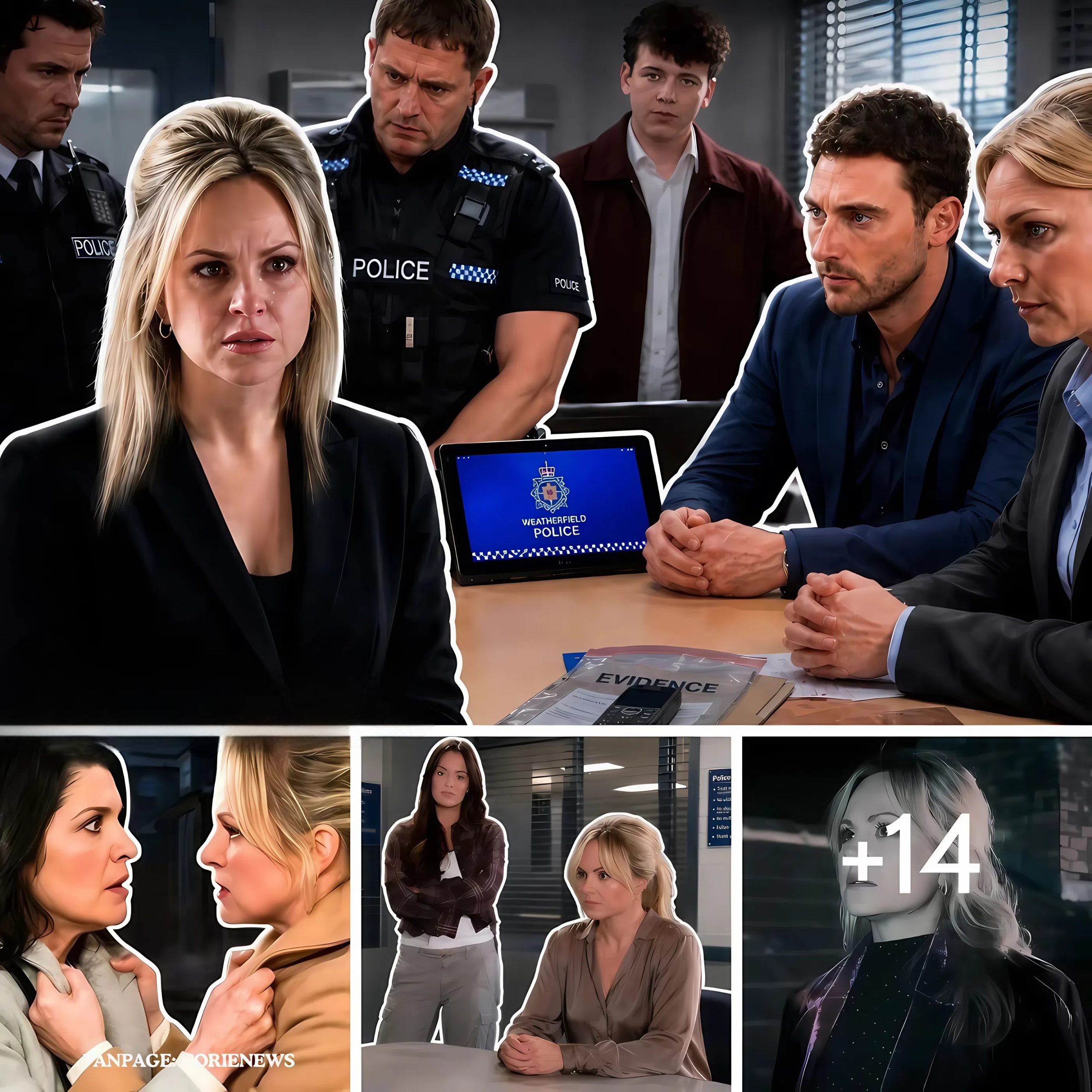
THE BIGGEST TWIST YET! SARAH’S LIFE SAVED! Hidden Evidence Proves She Didn’t Murder Theo! |
The cobbles of Weatherfield are once again at the center of a storm so intense that even longtime fans of Coronation Street are questioning everything they thought they knew about guilt, innocence, and survival. At the heart of this explosive drama stands Sarah Platt, a woman whose life has already been shaped by tragedy, trauma, and impossible choices—but now faces the most devastating accusation of all: murder.
Yet the question echoing through the rain-soaked streets is growing louder by the day—did Sarah truly kill Theo, or has she been trapped in a nightmare built on fear, confusion, and manipulation?
It all began on a dark, rain-lashed night in April on the scaffolding outside a Weatherfield building. Theo Silverson met his apparent end after a violent confrontation at height, falling to the ground below after a struggle involving Sarah. Witnesses and early assumptions pointed in one devastating direction: Sarah standing at the top, holding a metal pole, moments before Theo’s fatal fall.
But what if what everyone believes they saw… isn’t the full truth?
Sarah didn’t go looking for violence that night. She went searching for answers, specifically for Todd Grimshaw. Instead, she found herself face-to-face with Theo, a man increasingly portrayed as volatile, intoxicated, and dangerously fixated on psychological cruelty. In a moment that would change everything, Theo allegedly weaponized Sarah’s deepest trauma—reopening the wound of losing her son years earlier and pushing her into a mental and emotional breakdown.
From that perspective, Sarah’s actions begin to look less like calculated murder and more like an instinctive survival response. A woman cornered. A mother triggered. A past full of grief colliding violently with a present threat that felt all too real.
But even if the strike was not premeditated, the aftermath is where the true tragedy begins.

Because after Theo’s fall, Sarah did not call emergency services. She did not report what happened. Instead, she contacted Gary Windass—a man known for operating in the shadows of Weatherfield, someone who understands how to make problems quietly disappear. That single decision has become the pivot point of the entire investigation. Why call Gary instead of the police?
The answer may lie not in logic, but in conditioning. Sarah comes from a family where police involvement has never meant safety—it has meant exposure, scandal, and collapse. Her instinct is not to trust authority, but to contain chaos. Gary becomes her emergency exit from reality, a figure she believes can protect her from consequences she is too overwhelmed to face.
Yet that choice may have transformed a possible self-defense incident into something far more complicated: a cover-up.
Inside, Sarah is unraveling. She is caught in a suffocating spiral of guilt, fear, and emotional fragmentation. She is not only processing Theo’s death but also witnessing the fallout of her silence. The most devastating consequence is the imprisonment of Summer Spellman, a young woman now paying the price for a truth Sarah cannot yet confess. This burden is not just legal—it is psychological torture. Every day she remains silent, the weight of that decision deepens.
Sarah’s emotional state appears to be deteriorating rapidly. Her behavior suggests dissociation, a mental split between the woman she presents to the world and the woman carrying an unbearable secret. Moments of normality are shattered by sudden flashes of memory, panic, and guilt. Even seemingly ordinary events—like social dinners or conversations with her partner Kit Green—become psychological minefields.
Kit, a detective, unknowingly stands at the center of Sarah’s double life. On one hand, he is her partner and emotional anchor. On the other, he is the man investigating the very incident that could destroy her. Every interaction between them becomes layered with tension, especially as Sarah struggles to hide the truth from someone trained to uncover it.
Fans have even begun analyzing subtle dialogue for hidden meaning. One seemingly innocent remark—Kit mentioning “it’s a twist” in relation to a bottle opener—has sparked theories that he may already suspect more than he lets on. In a world like Weatherfield, nothing is ever truly accidental.
Meanwhile, Sarah’s fractured relationships continue to collapse around her. The most painful rupture comes from Todd, who ultimately distances himself after realizing the depth of what Sarah may have done. His rejection is not just emotional—it is moral. He cannot reconcile the woman he once trusted with the possibility of violence and deception. That loss strips Sarah of one of her last remaining emotional anchors.
But beneath the surface of accusation and guilt lies a far more complex theory—one that could change everything.
What if Sarah is not the final killer at all?
There is growing speculation that Theo may not have died immediately from Sarah’s strike. The blow may have caused the fall, but not instant death. If that is true, then another unknown individual could have arrived afterward and delivered the fatal injury. In that scenario, Sarah’s crime shifts dramatically—from murder to panic-driven involvement in an incident she did not fully control.
This theory introduces the possibility of a second figure on the scaffolding that night. Someone unseen. Someone with motive. Someone who may have wanted Theo silenced permanently. If proven, this revelation would completely rewrite Sarah’s legal and moral position.
Another emerging possibility revolves around witness testimony—particularly from Lily Platt. As a child, Lily may have observed something critical in the chaos of that night without fully understanding its significance. Soap history is filled with children who unknowingly hold the missing piece of a crime, and Lily could be the key to unlocking Sarah’s salvation—or confirming her guilt.
Psychologically, Sarah’s breakdown mirrors past trauma in her life. She has experienced loss, manipulation, and psychological distress before, and those unresolved wounds appear to be resurfacing under pressure. Her reaction to Theo is increasingly interpreted as a trauma response rather than criminal intent. In her mind, he was not just a man—he was a trigger for years of suppressed fear and grief.
However, the most controversial aspect of Sarah’s situation is not the incident itself, but what she chose to do afterward. By allowing silence to continue, and by failing to correct the narrative that led to Summer’s imprisonment, Sarah crosses a moral line that even sympathy struggles to defend. Self-defense may explain the moment—but silence defines the aftermath.
Her relationship with Gary further complicates matters. What began as a desperate call for help has evolved into a dangerous dependency built on shared secrets. Gary becomes both protector and potential liability, a man who understands exactly how deep Sarah is buried and how easily that truth could resurface.
And then there is Kit.
If Kit eventually uncovers forensic evidence—perhaps even DNA linking Sarah to the weapon—the emotional and professional collision will be catastrophic. He will be forced to choose between justice and love, between duty and denial. In that moment, Weatherfield will not just lose a case—it may lose a relationship entirely.
Still, the biggest question remains unresolved: was Theo’s death truly murder, or a tragic accident layered with misunderstanding, panic, and manipulation by forces still hidden from view?
If future revelations confirm that Sarah’s strike was not the direct cause of death, she could be legally cleared. But even if innocence is restored, emotional consequences would remain permanent. The psychological damage, the fractured relationships, and the knowledge of what her silence cost others may never fully heal.
The truth, as always in Coronation Street, is unlikely to be simple. It may not deliver full redemption or total ruin—but something far more unsettling: a grey zone where victim and perpetrator blur beyond recognition.
For now, Sarah Platt waits in limbo—haunted by memory, trapped by silence, and unknowingly standing at the center of a truth that could either destroy her forever… or finally set her free.