
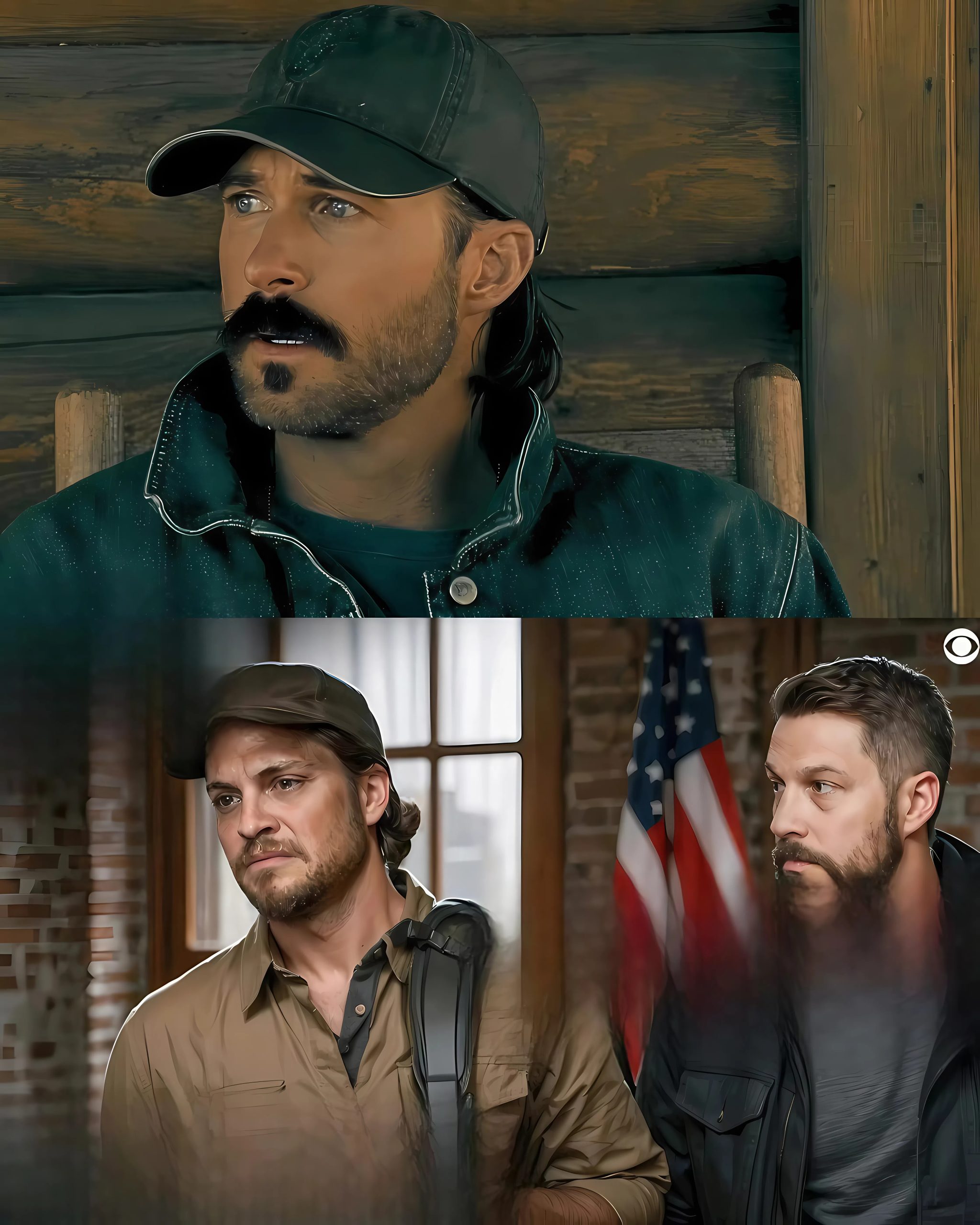
GARRETT FIGURED OUT CALVIN KNEW HE WORKS FOR CLEGG || MARSHALS SEASON 1 FINAL EPISODE SPOILERS
The season finale of Marshals leans heavily into the idea that consequences never stay buried for long. From the very first moments, the episode reinforces a core theme that has been building across the series: every decision made in the field, every cover-up, every act of violence, and every broken family bond eventually circles back with interest. Whether it’s battlefield trauma resurfacing, unresolved Dutton legacy tensions, or old rivalries reigniting, nothing in this world simply disappears.
For Kayce Dutton, portrayed by Luke Grimes, the pressure reaches a breaking point as old enemies, internal investigations, and personal doubts converge at once. The arrival of Garrett becomes a destabilizing force within the team, especially in his interactions with Kayce and Kalls. What should have been straightforward cooperation instead turns into an emotional minefield, forcing both men to confront buried memories from past conflicts they’ve never fully processed. Garrett’s presence doesn’t just strengthen their bond through shared experience—it exposes cracks that were already there.
At the same time, Randall Kleg, played with intense menace by Michael Cudlitz, escalates his long-running feud with Kayce and the Marshals unit into full-scale retaliation. His motivations are rooted in revenge for his family’s losses earlier in the season, and by the finale he has fully abandoned any restraint. Kleg’s plan is no longer about justice or legal maneuvering—it is about destruction. He begins assembling a private militia, signaling that the conflict has shifted from local law enforcement tension to open warfare.

Early in the episode, the structure feels slightly uneven, as the series attempts to balance character-driven reflection with procedural exposition. Much of the first act revisits backstory connections between Kayce, Garrett, and other team members. Some of this is delivered through dialogue that feels unusually direct, almost as if the writers are filling in gaps rather than allowing performances to communicate subtext. Garrett’s explanations of shared wartime experiences, in particular, come across as overtly instructive, slowing the momentum.
But that pacing issue is quickly overshadowed once the external threats intensify.
Randall Kleg’s retaliation takes a deeply personal turn when Andrea Cruz is abducted under his orders. This act immediately raises the stakes, transforming the conflict from legal disputes and internal investigations into a life-or-death crisis. Kleg is no longer reacting—he is escalating deliberately, using Andrea as leverage against Kayce and the Marshals team.
At the same time, Chief Deputy Marshal Harry Guilford begins tightening his scrutiny of Kayce. Guilford, increasingly convinced that Kayce represents a long-term liability, leans on a complaint filed by Kleg claiming that his son was unarmed when Kayce shot him earlier in the season. This leads to Kayce being temporarily benched and placed under internal review. Though the suspension barely lasts, it creates enough disruption to fracture team cohesion.
Andrea, Bell, and Miles are pulled into a parallel investigation meant to either justify or dismantle the allegations against Kayce. Guilford’s intentions are clear: if Kayce can be removed without triggering exposure of the broader Dutton family history, he will be. The implication hangs heavily over every interaction. Andrea, in particular, finds herself torn between loyalty to her team and pressure from Guilford, who subtly suggests that her cooperation could secure her long-desired transfer back to Washington, D.C.

The investigation itself spirals into a confusing web of competing theories, old Yellowstone-era references, and circumstantial evidence. At one point, past events involving Tate’s kidnapping are even revisited as potential motive threads, though the connections feel strained. Much of this subplot circles without resolution, reinforcing the sense that procedural mechanics are being used more as scaffolding than as a driving force.
Eventually, the team discovers trail camera footage that conclusively proves Kayce acted within justified parameters during the shooting in question. The revelation clears his name almost instantly, exposing the fragility of the investigation. While Kayce is vindicated, the damage to trust within the team is already done. Guilford remains unsatisfied, Andrea feels manipulated, and Bell and Miles are left questioning why they were ever turned against one of their own in the first place.
Simultaneously, Kayce and Kalls are diverted into a high-risk search and rescue mission involving a missing helicopter carrying a wealthy landowner and his pilot. The mission begins as a routine recovery operation but quickly spirals into chaos due to extreme weather conditions and unpredictable terrain. During their search, they encounter a reclusive armed man living off the grid. Though he initially threatens them at gunpoint, Kayce quickly disarms the situation, instructing him to report to the ranger station rather than escalate the confrontation.
The search eventually leads them to a crash site where the helicopter has gone down. The pilot is gravely injured, and the landowner, Tom Weaver, is shaken but alive. As the weather worsens, evacuation becomes increasingly difficult. A sudden encounter with a bear briefly interrupts the rescue effort, adding further danger and confusion. Although the animal is quickly driven off, the chaos contributes to the pilot’s eventual death due to worsened injuries.
Weaver survives, but the emotional aftermath of the incident becomes more significant than the physical danger. Kayce, initially frustrated with Weaver for putting them in a dangerous situation, ultimately shares a quiet moment of reflection with him about living under the shadow of powerful family legacies. That conversation mirrors Kayce’s ongoing internal struggle with the Dutton name and what it has cost him.
Back at the Marshals office, Calvin’s storyline takes a darker and more complicated turn. It is revealed that Calvin has been hiding a deeper connection to Maddie, the bartender, as her estranged father. His involvement in the Marshals unit was partially motivated by a desire to reconnect with her, though his efforts have largely failed due to years of absence and mistrust.
The finale twist, however, arrives when Garrett uncovers a far more dangerous truth: Calvin has been secretly aware that he is operating under the influence of Randall Kleg’s wider network. More importantly, Garrett pieces together that Calvin has known for some time that he has been indirectly working for Kleg’s interests. This realization reframes Calvin’s past actions and raises questions about whether he has been a pawn, a willing participant, or something far more calculating.
This revelation lands just as Kleg’s militia begins closing in on Marshals positions, confirming that the conflict has escalated into a coordinated assault. Andrea’s captivity becomes the emotional and tactical center of the episode, pushing Kayce into a more aggressive stance than we have seen all season. For the first time, the team feels genuinely outmatched, underscoring Kleg’s transformation into a legitimate season-level antagonist rather than a background threat.
The final act culminates in a brutal gunfight that traps the Marshals in a defensive position while Andrea remains in enemy hands. The sequence is chaotic, intense, and deliberately unresolved, ending on a cliffhanger that signals an even larger escalation ahead. It is a moment designed less for closure and more for momentum, ensuring that the audience is pulled into what comes next.
Throughout the episode, Marshall Guilford continues to serve as a philosophical counterweight to Kayce. His belief that Kayce is fundamentally unstable—and that the Dutton legacy will eventually destroy everyone around him—remains a central tension. While his methods are often questionable, his skepticism is not entirely unfounded. Kayce’s history of shifting loyalties, moral ambiguity, and impulsive decision-making gives weight to Guilford’s warnings, even if his timing is increasingly aggressive.
The series also continues to explore broader themes tied to the universe established in Yellowstone, as well as its prequels 1883 and 1923. The idea of land ownership, generational violence, and institutional corruption remains central, but Marshals struggles at times to fully distinguish its procedural identity from its parent franchise.
Behind the scenes of the storytelling structure, there is also a sense of transition. The influence of creator Taylor Sheridan is clear in the blending of Western grit with modern law enforcement drama, though this series is still searching for its balance between case-of-the-week storytelling and serialized tension.
By the end of the finale, Marshals leaves viewers with a mix of satisfaction and uncertainty. The main conflict is far from resolved, Andrea’s fate remains uncertain, Kleg is more dangerous than ever, and Calvin’s hidden alignment raises new questions about internal betrayal. Garrett’s discovery about Calvin knowing more than he admitted adds yet another layer of mistrust that will almost certainly shape the next season.
It is not a clean ending, nor is it meant to be. Instead, it functions as a pressure point—one that suggests the explosion is still coming, not that it has already happened.