El Padrino Has Arrived And The Ten Petal Ranch Will Never Be The Same — Episode 9 Explained
El Padrino Has Arrived And The Ten Petal Ranch Will Never Be The Same — Episode 9 Explained
Inside the collapsing world of Yellowstone and its expanding frontier of power, violence, and legacy wars, Episode 9 of this arc doesn’t behave like a finale—it behaves like a detonation point. Every alliance that once held the Ten Petal Ranch together is now exposed, fractured, and ready to snap. And at the center of it all is a single arrival that rewrites every rule the characters thought they understood.
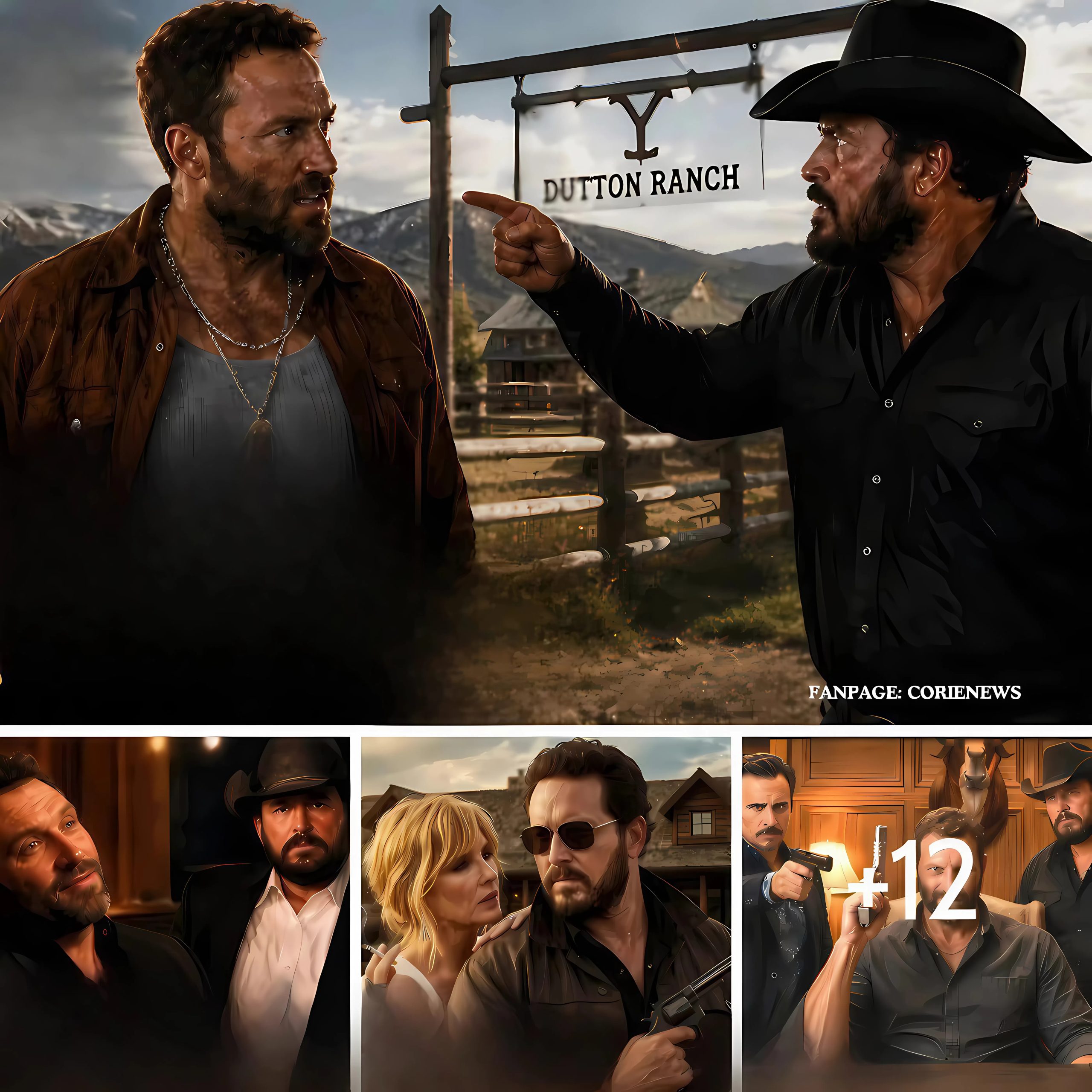
Mariano Reyes—known in the shadows as “El Padrino”—has stepped out of the darkness and into the Ten Petal Ranch, and nothing about this land, this family, or this empire will survive unchanged.
The episode opens in the aftermath of escalating violence. Conversations are no longer strategic—they’re desperate. Threats are no longer symbolic—they’re final. A man is told he is already dead, another answers without hesitation that he has nothing left to lose. What once felt like a local power struggle has now become something much larger: a war between inherited control and absolute outside domination.
Mariano Reyes’ arrival is not subtle. It is not negotiated. It is not even announced in the traditional sense. It simply happens—like a shadow crossing over the land, shifting the balance of power without a single shot fired. His reputation precedes him: a borderlands smuggling kingpin who has built his empire through silence, fear, and precision. And now that same presence is standing inside the gates of Ten Petal Ranch.
From the moment he appears, every power dynamic inside the ranch begins to collapse inward.
Rob Will—who has been trying to seize control in the absence of stability—finds himself unraveling in real time. His leadership has already been marked by reckless decisions: firing long-time ranch hands, pushing unstable business deals, and treating inherited power as something he owns rather than something he must earn. But now, all of that ambition suddenly feels irrelevant. Mariano Reyes doesn’t acknowledge Rob Will’s authority. He doesn’t challenge it either. He simply overshadows it.
Because men like Mariano don’t compete for control.
They replace it.
Meanwhile, the true anchor of the ranch—Beulah—returns from the edge of medical collapse only to find her empire burning from within. Her absence has allowed chaos to grow unchecked, and what she sees upon returning is not just mismanagement, but structural decay. The ranch is no longer stable enough to defend itself from internal betrayal, let alone an external force like Mariano Reyes.
But Beulah’s real problem is not Rob Will’s incompetence. It is the debt she once made to Mariano himself.
That debt is the hidden foundation of everything now collapsing around her.
Years earlier, Beulah took in Joaquin under circumstances tied directly to Mariano’s criminal world. That act created a fragile agreement: as long as she protected his bloodline and kept Joaquin safe, Mariano would remain distant. Invisible. Controlled.
But that agreement has now been broken—not by violence, but by choice.
Beulah’s public decision to side with Rob Will over Joaquin is the moment everything shifts. It is not just betrayal in a personal sense. It is the cancellation of protection. And with Mariano Reyes, canceled protection does not mean freedom—it means exposure.
Now he is here.
And he is no longer obligated to stay away.
The confrontation between Beulah and Mariano becomes one of the most charged sequences in the episode. It is not loud. It is not chaotic. It is controlled in a way that makes it more dangerous. Every word carries decades of unspoken history. Every pause feels like a warning.
Beulah tries to negotiate. She tries to reframe the past. She tries to appeal to whatever remains of old understanding between them.
But Mariano is not here for reconciliation.
He is here because a vacuum has opened.
And men like him do not ignore vacuums—they fill them.
Rob Will, for his part, still does not fully comprehend what has arrived on his land. He understands that Joaquin called Mariano. He understands that the situation has escalated beyond anything he can control. But he does not understand the fundamental shift that has already occurred: the question is no longer whether he is fit to run the ranch.
The question is whether the ranch will remain his to run at all.
Because Mariano Reyes does not travel into contested territory without purpose. He does not arrive to support one side in a family dispute. He arrives when something valuable is exposed and unstable enough to be taken.
And Ten Petal Ranch, in its current condition, is both.
Joaquin’s arc becomes the emotional fracture point of the episode. He believed calling his biological father would bring protection. Justice. Resolution. Instead, he has triggered something far more uncontrollable.
Now he stands at the center of two worlds: the ranch that raised him in loyalty and sacrifice, and the father who raised him in shadow and survival.
Mariano did not come as a savior.
He came as a force of nature.
And Joaquin begins to realize the terrifying possibility that his attempt to protect himself may have placed everyone he knows in greater danger than before.
This realization transforms his entire emotional journey. He is no longer just a son caught between identities. He is the accidental bridge between two competing systems of power—one built on land and legacy, the other built on secrecy and enforcement.
And bridges, in this world, are always the first things to burn.
As Mariano’s influence spreads through the ranch, the episode begins to widen its focus. Beth and Rip are no longer observers. They are active participants in a conflict they never agreed to join.
Beth, already hardened by years of political and financial warfare, recognizes immediately that Mariano operates on a completely different level than the enemies she is used to. She has fought corporations, politicians, and land developers. She understands legal manipulation and economic pressure.
But Mariano Reyes does not operate in those systems.
He operates outside them entirely.
And that makes him unpredictable in a way she cannot easily control.
Rip, meanwhile, is trapped in an increasingly dangerous triangle. Rob Will is spiraling into paranoia and recklessness. Mariano’s men are moving through the ranch like they already belong there. And the consequences of past violence—particularly the unresolved evidence tied to Sheriff Wade’s office—are closing in from another direction entirely.
Rip has always been a man of direct solutions. But this situation offers none. Every choice carries exposure. Every action creates a new vulnerability. And for the first time, his instinct for control becomes a liability instead of a weapon.
Even Carter’s storyline, running parallel in emotional isolation, deepens the episode’s sense of collapse. He is no longer just a runaway boy. He is a vulnerable target in a landscape that no longer has boundaries. The wilderness he thought would give him freedom instead exposes him to dangers he never understood.
Beth searches for him in exhaustion and fear. Rip follows old trails with quiet dread. And Carter slowly realizes that independence without preparation is not freedom—it is exposure.
When father and son eventually come face-to-face again, it is not framed as triumph. It is framed as consequence. Rip does not react with relief alone. He reacts with the weight of everything Carter does not yet understand about survival, responsibility, and consequence.
And Carter, having been forced to confront real danger, begins to understand that the life he rejected may have been the only thing keeping him alive.
By the time the episode moves toward its final stretch, every storyline has converged around the same unavoidable truth: control of Ten Petal Ranch is no longer an internal dispute.
It is an open question waiting to be answered by whoever has the strongest claim—and the strongest will—to take it.
Mariano Reyes stands at the center of that question.
Rob Will is collapsing under its weight.
Beulah is trying to hold together a system already breaking apart.
And Joaquin, Beth, Rip, and Carter are all caught in the expanding radius of a conflict they did not create—but can no longer escape.
The final question the episode leaves hanging is not who wins the ranch.
It is whether the ranch survives long enough for anyone to claim it at all.
Because when El Padrino arrives, he does not just change ownership.
He changes what ownership even means.
And in the world of Yellowstone, that kind of shift doesn’t end a story.
It starts a far more dangerous one.