Why’d Rip Do It? 23 Burning Questions About Dutton Ranch Ending [Ep. 1+2 Breakdown]
Fans of Yellowstone were thrown right back into the dust, blood, and heartbreak of the Dutton universe when the new spin-off “Dutton Ranch” opened with Rip Wheeler standing over another disaster he never asked for. The first two episodes waste no time reminding viewers exactly why this franchise became such a phenomenon in the first place. There are damaged souls, family feuds, buried secrets, brutal violence, and quiet moments of tenderness hidden beneath all the chaos. But more than anything, the show feels like a deliberate return to the emotional atmosphere of early Yellowstone.
Episode 1 begins with Rip and Beth trying to rebuild their lives after tragedy destroyed everything they had worked for in Montana. A lightning-fueled wildfire ripped through their ranch near Dillon, leaving almost nothing behind. Instead of rebuilding from the ashes, they chose to leave. Texas became their fresh start after Walker helped connect them with a ranching opportunity down south. The move was supposed to give Beth and Rip something they rarely had before: peace.
For a brief moment, it actually seemed possible.
The opening scenes between Beth and Rip carry a softer tone than longtime viewers are used to seeing. Beth, normally razor-sharp and emotionally explosive, appears calmer. Rip even allows himself to imagine a future that doesn’t revolve around survival and violence. Those quiet conversations hit especially hard because viewers know happiness never lasts long in the Yellowstone universe.
The show immediately draws direct parallels to Yellowstone’s pilot episode. One of the most obvious callbacks comes when Beth comforts an injured horse. Fans instantly remembered the heartbreaking opening scene of Yellowstone when another suffering horse had to be put down. This time, however, things unfold differently. Instead of death, Dr. Everett McKenna steps in and manages to save the animal.
Everett’s arrival instantly changes the energy of the series.
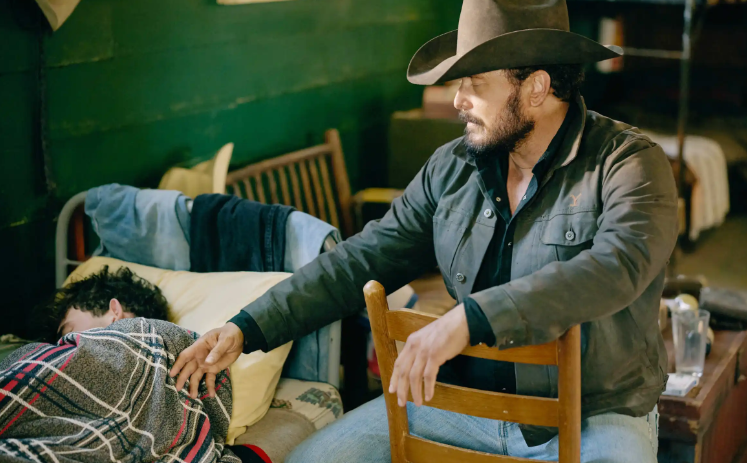
Played with quiet authority and mystery, the old cowboy quickly becomes one of the most intriguing figures in Dutton Ranch. He first appears after Carter gets into a violent altercation with a rodeo cowboy, but his deeper connection to Beth begins when he helps save the injured horse. Everett carries himself like a man who has seen war, pain, and loss firsthand. The detail on his hat reveals an important clue: he once served with the U.S. Navy Seawolves helicopter squadron during the Vietnam War.
That military background likely means far more than the show has revealed so far.
Everett understands violence the same way Rip does — not as entertainment, but as necessity. Yet there’s something suspicious about him too. He already knew the previous ranch owners, and his knowledge of the area feels deeper than he admits. Some viewers are beginning to suspect Everett may secretly have ties to Bula Jackson and the rival 10 Petal Ranch.
And speaking of Bula Jackson, she may already be shaping up as one of the franchise’s most dangerous villains.
Unlike previous Yellowstone enemies who relied mainly on corporate greed or political manipulation, Bula rules through emotional intimidation and ruthless control over her family. Her son Rob Will is unstable, violent, and heavily addicted to drugs. Early in the story, he murders the 10 Petal Ranch foreman Wes during a rage-filled confrontation. Instead of reacting with horror, Bula immediately focuses on covering it up.
That tells viewers everything they need to know about her.
She cares more about maintaining power than protecting innocent people. Even worse, it becomes increasingly obvious that she helped create the monster her son became. During one explosive confrontation, Oriana accuses her grandmother of shaping Rob Will’s cruelty through years of manipulation and emotional abuse.
Oriana quickly emerges as one of the breakout characters of the series.
At first, some fans feared she would simply become another glamorous distraction with little substance. Instead, she proves emotionally layered, rebellious, and deeply conflicted. She despises the toxic culture surrounding her family but remains trapped inside it. Her chemistry with Carter creates one of the most emotionally fragile storylines in the series.
And that relationship may become a disaster.
Carter already carries emotional scars from his difficult upbringing, and the first two episodes repeatedly show him struggling to find where he belongs. After being manipulated into buying alcohol for teenagers and later arrested following a rodeo fight, Carter seems desperate for connection. Oriana gives him hope, but the reality of who she is — daughter of Rob Will and granddaughter of Bula — places him directly in the middle of an emerging ranch war.
That’s why many viewers now believe Carter may be the injured person shown in the medical helicopter from earlier trailers.
The warning signs are everywhere.
Rip even tries to guide Carter through his growing confusion about women and relationships in one of the show’s most memorable scenes. His advice is pure Rip Wheeler wisdom: when women talk, you listen — whether they’re being kind, angry, or making no sense at all. The moment is funny on the surface, but it also reveals Rip attempting to become the father figure Carter never had.
But Rip’s own darkness still follows him everywhere.
The biggest shock of Episode 2 arrives during the horrifying climax involving Wes’s corpse. Earlier, Rip secretly discovers the dead foreman buried on his property. Instead of immediately calling the police, he digs up the body, stores it in a freezer overnight, and later disposes of it by throwing it down an abandoned mineshaft.
The decision stunned viewers.
Why would Rip destroy evidence instead of reporting a murder?
The answer lies in everything audiences already know about him. Rip Wheeler has spent most of his life operating outside the law. He doesn’t trust police, institutions, or systems of justice because none of them ever protected him growing up. He learned long ago that survival depends on handling problems personally.
In Montana, the Yellowstone ranch had the infamous “train station” where enemies disappeared forever. Texas now has its own version.
Rip also understands how suspicious he would appear if authorities discovered a body on his property. He has no legal identity history that would reassure investigators. To outsiders, he would immediately look guilty. From his perspective, eliminating the body is the safest way to protect Beth and preserve the fragile new life they’re trying to build.
That motivation makes the scene even more tragic.
Rip isn’t disposing of the body because he enjoys violence. He’s doing it because protecting Beth has become the central purpose of his life. Everything else comes second. Unfortunately, actions like these may destroy the very peace he’s trying to preserve.
The final moments of Episode 2 strongly suggest that disaster is already approaching.
The dead foreman’s wife has filed a police report accusing the 10 Petal Ranch of a cover-up before leaving town. Rob Will remains dangerously unstable. Bula’s authority is beginning to crack as Oriana openly rebels against her control. Carter is emotionally vulnerable and romantically entangled with the enemy family. And Rip has now secretly hidden evidence connected to a murder investigation.
Every storyline is heading toward collision.
One especially fascinating mystery involves Oriana’s missing mother. The show repeatedly hints at unresolved trauma connected to her disappearance. Did she abandon the family to escape Bula’s control? Was she driven away by Rob Will’s violence? Or did something far darker happen?
The fact that the series keeps mentioning absent family members strongly suggests future revelations are coming. Rob Will’s father is also mysteriously absent despite being referenced multiple times. In Yellowstone-style storytelling, missing parents almost always return eventually — usually bringing more conflict with them.
Another major question centers on Walker.
The series mentions him as the person who helped Rip and Beth relocate to Texas, but viewers still haven’t seen him onscreen. Many fans expect his eventual appearance, though there’s concern about the spin-off leaning too heavily on Yellowstone nostalgia rather than establishing its own identity.
Still, the callbacks largely work because they feel emotional rather than forced.
The atmosphere, music, dialogue, and cinematography all intentionally echo the early seasons of Yellowstone when the franchise focused more on family survival than political conspiracies. Songs like “Willing and Able” by Charles Wesley Godwin and Cassidy Daniels’ “Heart-Shaped Necklace” reinforce the lonely western mood that made the original series so powerful.
Most importantly, the show understands what made Rip and Beth compelling in the first place.
Underneath the violence, sarcasm, and rage are two broken people desperately trying to build a home together. Dutton Ranch isn’t really about cattle, rodeos, or land disputes. It’s about whether people shaped by trauma can ever truly escape the darkness behind them.
After these first two episodes, the answer still seems uncertain.
Rip may have buried a body down a mineshaft, but he definitely didn’t bury the past. And in true Yellowstone fashion, the past is already clawing its way back to the surface.